

Commentary
In an interview, Jim Lamson discusses the ongoing regional conflict and sees an unclear picture when it comes to winners and losers.
Michael Young
{
  "authors": [
    "Mohamad Fawaz"
  ],
  "type": "commentary",
  "blog": "Diwan",
  "centerAffiliationAll": "",
  "centers": [
    "Carnegie Endowment for International Peace",
    "Malcolm H. Kerr Carnegie Middle East Center"
  ],
  "englishNewsletterAll": "",
  "nonEnglishNewsletterAll": "",
  "primaryCenter": "Malcolm H. Kerr Carnegie Middle East Center",
  "programAffiliation": "",
  "regions": [
    "Lebanon",
    "Israel",
    "Levant"
  ]
}
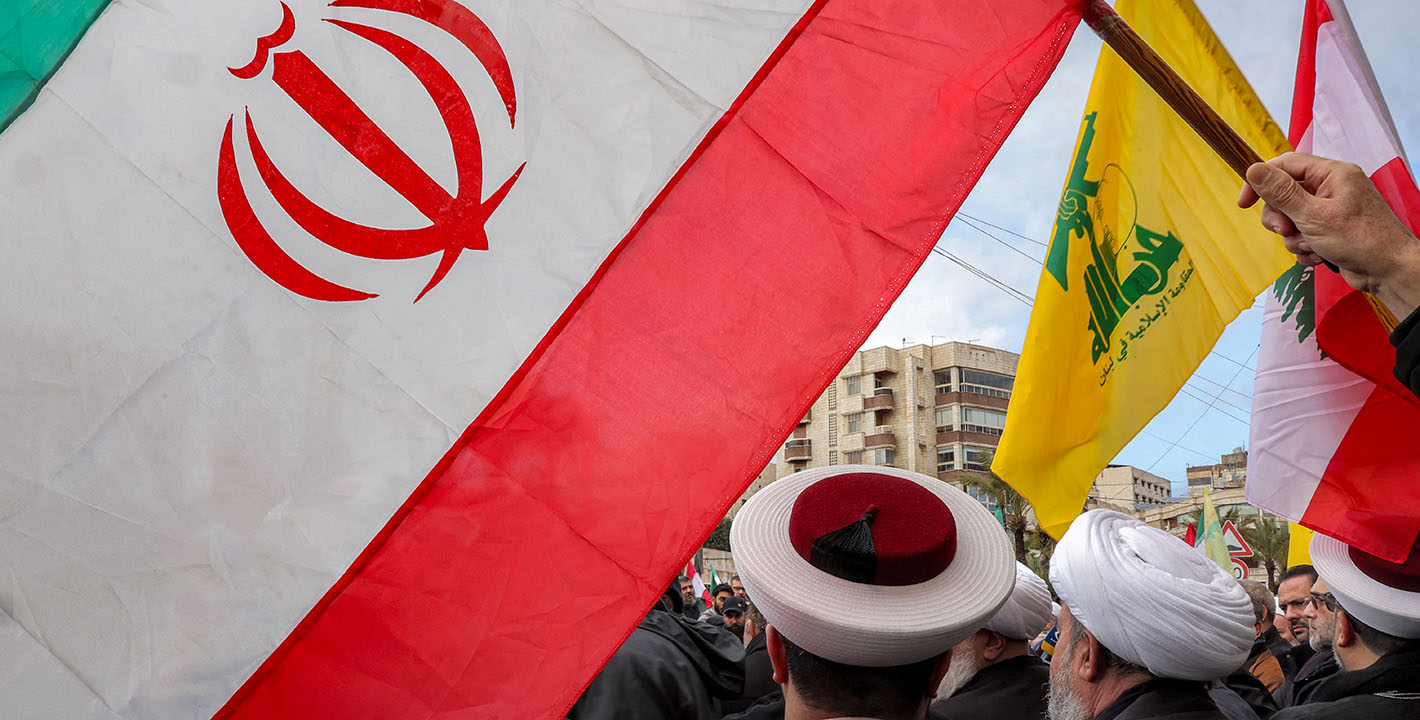
Source: Getty
The community seeks maintain a distance from Hezbollah, and an even greater one from normalization with their southern neighbor.
On April 16, President Donald Trump announced a ceasefire between Lebanon and Israel. This failed to resolve any of the outstanding issues between the two countries, such as the Israeli occupation of southern Lebanese land. These issues were left for direct negotiations between the sides, which began on April 14 in Washington, under U.S. auspices, and resumed on April 23.
After the ceasefire, different groups in Lebanon expressed sharp differences over how the negotiations should take place, and what they should seek to achieve. Attention was primarily focused on the more hardline groups, primarily the Christian Lebanese Forces Party, which is focused on disarming Hezbollah, and Hezbollah itself, which, with its Shiite base, opposes negotiations. However, the Sunni community has largely remained away from the spotlight, probably because of its fragmented political leadership.
Generally, the Sunni approach to Lebanese relations with Israel has been shaped by complex, intertwined, and even conflicting factors. First, religion and history continue to play a major role in determining Sunni perceptions. An older generation supported, embraced, and even fought with the Palestinian organizations in Lebanon, with the aim of liberating Palestine at a time when the Palestinian cause and hostility toward Israel were central to the Sunnis’ self-definition in Lebanon and the region. At the same time, the past two years have strengthened anti-Israel sentiment among a younger generation of Sunnis. On top of that, a quick examination of Friday sermons in Lebanese mosques would show a focus on the threat posed by Israel and its plans in Lebanon, and highlight the religious prohibition of normalizing with the Israelis.
At the same time, Sunnis have always been state-oriented, supporting the state and abiding by its decisions, even when they might object to specific government policies. This helps to explain why many in the community have rallied around Prime Minister Nawaf Salam. It is less the person that they support than the fact that Salam is the foremost Sunni representative in the state, therefore any setbacks he suffers might affect the community as a whole.
The third factor influencing Sunni attitudes today is the fear that Hezbollah may turn its weapons inward once the conflict with Israel ends, as it did in the aftermath of the July 2006 war and during the May 7, 2008 standoff with the government of then-prime minister Fouad al-Sanioura. Those memories were revived by Hezbollah’s recent threats and by rallies led by party supporters in Beirut, especially in predominantly Sunni neighborhoods. This has pushed the Sunni community to rally more closely around the state and Salam.
A fourth factor is the absence of a strong Sunni political leadership capable of unifying the community and articulating a political direction that can transcend Sunni differences, fears, and aspirations.
A fifth factor is geography. Contrary to common assumptions, the political and demographic weight of the Sunni community is not only concentrated in northern Lebanon, but also in the south, from Sidon to villages in the Arqoub region, as well as the six Sunni border villages in the southwestern border area—Yarin, Marwahin, Dhayra, Al-Bustan, Al-Zalloutiyeh, and Umm al-Tut—which were heavily destroyed and depopulated during the 2024 war. The Israelis have also targeted the Beqaa Valley, so that the further south one travels, the greater the level of Sunni hostility directed against the Israelis, and the greater the sympathy for the resistance narrative of Hezbollah and its supporters.
A sixth and overarching factor is the Sunnis’ regional connections. In the face of competing influences on the community from countries around the Middle East, and in the absence of a unified local Sunni leadership, the role of the broader region in shaping Sunni attitudes in Lebanon has become more pronounced. Over the past two decades, this regional environment, especially among the Gulf states, has largely been defined by antagonism towards Iran and Hezbollah. However, Israel is once again perceived today as a central source of threat.
This shift is evident in recent Turkish statements, notably those of Foreign Minister Hakan Fidan at the Antalya Diplomacy Forum this month. Fidan declared, “Israel is not after its own security. Israel is after more land. Security is being used by the Netanyahu government as an excuse to occupy more land.” As for Saudi Arabia, despite earlier expectations that it was nearing a normalization deal with Israel, the war in Gaza and other military escalations around its borders have driven the two sides further apart. Riyadh appears unwilling to accept a regional order led by Israel, just as it has rejected the idea of one led by Iran, at a time when Israeli Prime Minister Benjamin Netanyahu has threatened what he calls an “emerging radical Sunni Axis.”
Taken together, these outlooks reflect a broader regional reordering of priorities and enmities. This will shape how regional powers approach Lebanon and influences Sunni attitudes inside the country. Such a direction is also reflected in the strengthening of Parliament Speaker Nabih Berri’s ties with Saudi Arabia, to which he recently dispatched his political aide Ali Hasan Khalil, while at the same time reaffirming his rejection of direct negotiations. His comments coincided with reports suggesting that Riyadh has reservations about Lebanon rushing alone into a negotiation track with Israel without wide-ranging domestic and Arab support.
Syria has also emerged as an important convergence point between Türkiye and several Arab Gulf states, especially Saudi Arabia, to the extent that it has become the principal arena of confrontation with Israel. Moreover, given Sunni frustration over decades of marginalization in Syria, the new Syria is beginning to determine, partly, the Lebanese Sunni community’s political compass. From this perspective, Syria’s stance toward Israel has hardened and it rejects any move toward a peace agreement, insisting on security arrangements only. Syria has also echoed warnings about Israeli’s expansionist ambitious, while seeking to calm tensions with Hezbollah, albeit without embracing the party’s choices or forgetting the grievances it holds against the party. This attitude, in many ways, comes close to reflecting the mood in Lebanon’s Sunni community.
Accordingly, at the individual level Sunni attitudes are shaped by the degree to which these factors are present in each person, as well as by the extent to which they intersect with personal interests and circumstances. At the broader collective level, however, the prevailing Sunni sentiment appears to be to maintain a distance from Hezbollah’s orientations, while keeping an even greater distance from the idea of normalizing with Israel. These two dimensions are unfolding in parallel. Such an attitude is likely to deepen and evolve depending on the relationship between the Arab states and Türkiye, on the one side, and Israel on the other, at a time when regional rivalries are growing more intense. They are moving from a predominantly Shiite-Israeli confrontation to a Muslim-Israeli one, but with different tools and without a Sunni-Shiite rapprochement. Syria and Lebanon are likely to remain the main arenas for this confrontation.
Mohamad Fawaz
In an interview, Jim Lamson discusses the ongoing regional conflict and sees an unclear picture when it comes to winners and losers.

Michael Young
Unless Beirut lowers expectations, any setbacks will end up bolstering Hezbollah’s narrative.

Mohanad Hage Ali
Lebanon’s largest water reservoir is a house of many mansions when it comes to converging failures.
Camille Ammoun
Cairo’s efforts send a message to the United States and the region that it still has a place at the diplomatic table.

Angie Omar
Beirut’s desire to break free from Iranian hegemony may push it into a situation where it has to accept Israel’s hegemony.
Michael Young